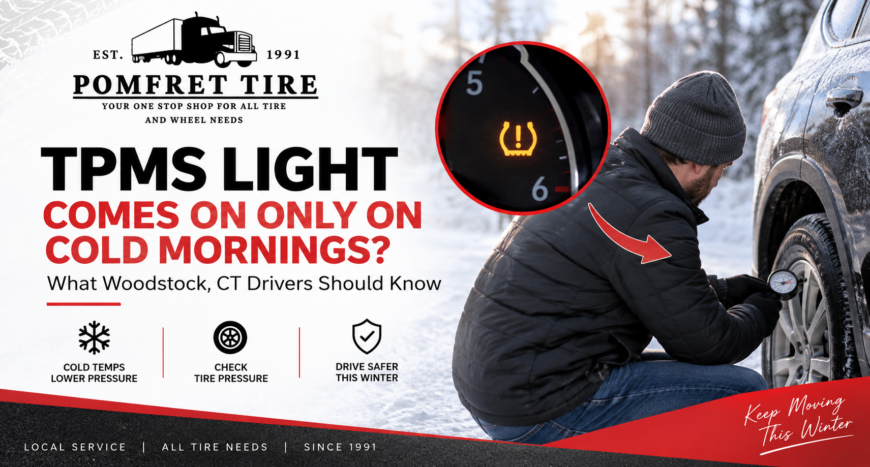

You start your car on a cold morning in Woodstock, CT, and suddenly the TPMS warning light appears on the dashboard. Later in the day, when the temperature rises, the light may disappear. This can be confusing, especially when your tires looked perfectly fine the day before.
Cold weather can affect tire pressure, so a TPMS light during fall or winter does not always mean you have a flat tire. However, it should not simply be ignored. Understanding why temperature affects tire pressure can help you know when a basic pressure adjustment may be enough and when your tires or TPMS system should be inspected.
What Does the TPMS Light Mean?
TPMS stands for Tire Pressure Monitoring System. Its purpose is to alert the driver when one or more tires become significantly underinflated.
The warning does not tell you exactly why the pressure is low. It could be related to changing temperatures, a slow leak, a puncture, a valve problem, or another tire issue.
If you are unsure why the warning has appeared, a tire professional such as Pomfret Tire can inspect the tires and TPMS system to help identify the cause.
Why Does the TPMS Light Appear on Cold Mornings?
Tire pressure changes with temperature. As the outside temperature falls, the air inside the tire contracts and the measured pressure decreases. According to the U.S. Department of Energy, tire pressure typically changes by roughly 1 PSI for every 10°F change in outside temperature.
Imagine your tire pressure was already close to the point that triggers the TPMS warning. An overnight temperature drop may lower it enough for the warning light to appear when you start the vehicle in the morning.
As you drive and the day becomes warmer, tire temperature and pressure can increase. The warning may then disappear. That does not necessarily mean the original low-pressure condition should be forgotten.
Should You Add Air Immediately?
If the TPMS light appears, check all four tires with an accurate tire-pressure gauge when the tires are cold. Use the recommended cold tire pressure listed by the vehicle manufacturer, usually found on a label inside the driver’s door or in the owner’s manual.
Do not use the maximum pressure printed on the tire sidewall as your target unless it happens to match the vehicle manufacturer’s specification.
Also avoid intentionally overinflating tires simply because colder weather is expected. Tire pressure should be adjusted according to the vehicle manufacturer’s recommendation.
What If the Light Keeps Coming Back?
A warning that repeatedly appears deserves more attention.
If one tire consistently loses pressure while the others remain stable, there may be a slow leak. A small puncture, valve stem problem, bead leak, wheel issue, or other condition could allow air to escape gradually.
Sometimes the problem is related to the monitoring system rather than tire pressure itself. Drivers searching for TPMS repair near me in Woodstock, CT may benefit from having both the actual tire pressures and the TPMS components checked rather than assuming the sensor is automatically responsible.
A Flashing TPMS Light Can Mean Something Different
Pay attention to how the dashboard light behaves.
A light that stays steadily illuminated generally indicates that the system has detected low tire pressure. A TPMS warning that flashes for approximately 60–90 seconds after startup and then remains illuminated can indicate a malfunction in the monitoring system.
Possible causes vary by vehicle and may include a sensor or communication problem. If the light flashes repeatedly at startup, professional diagnosis can help determine what is happening.
Don’t Judge Tire Pressure by Appearance Alone
Modern tires can lose a noticeable amount of pressure without looking obviously flat. Looking at the tire from outside is therefore not a reliable substitute for using a pressure gauge.
This becomes particularly important during Connecticut’s colder months, when temperatures can change considerably between daytime and nighttime.
Check tire pressure regularly and before long trips. If you notice cuts, bulges, exposed material, severe cracking, or another obvious sign of damage, avoid assuming that adding air will solve the problem.
Tire Pressure Matters Beyond Passenger Cars
Temperature and proper inflation are important for many types of tires, not only passenger vehicles. Trucks, trailers, tractors, and other equipment also depend on appropriate tire pressure for their specific loads and operating conditions.
For farms and equipment operators, professional Agricultural tire service for farms in Dayville, CT can help address agricultural tire concerns that differ from the TPMS systems commonly found on passenger vehicles.
The important point is that every vehicle or piece of equipment should follow the correct inflation recommendations for its application rather than relying on a general pressure number.
When Should You Have the Tires Checked?
Consider having the tires inspected when the warning remains on after pressures have been correctly adjusted, one tire repeatedly loses air, the TPMS light flashes, or you notice visible tire or wheel damage.
A sudden pressure loss while driving deserves immediate attention. If a tire is visibly flat or the vehicle becomes difficult to control, slow down carefully and stop in a safe location rather than continuing to drive on a potentially damaged tire.
Final Thoughts
A TPMS light appearing only on cold Woodstock mornings can simply be the result of temperature-related pressure changes, especially when the tires were already near the warning threshold. But the warning is still useful information.
Check the tires when they are cold, compare the readings with the vehicle manufacturer’s recommended pressure, and continue monitoring them. If one tire repeatedly loses pressure or the warning continues after proper inflation, an inspection can help determine whether there is a slow leak, tire problem, or TPMS malfunction.
Paying attention to a small dashboard warning today can help prevent a larger tire problem later.


